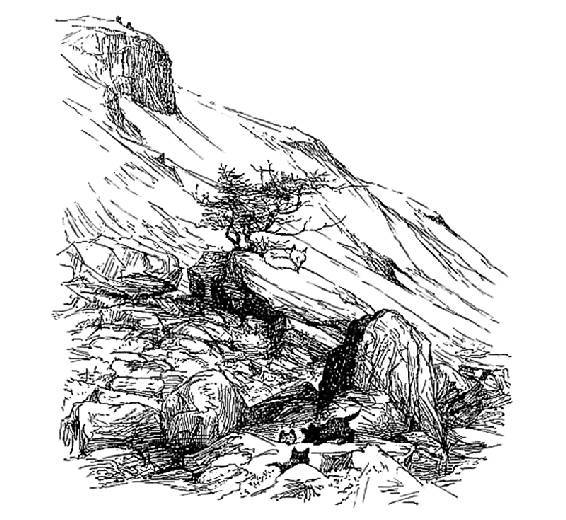
“Grown sheep can get crag-fast,” said Belle Lingcropper, “I was fast in Falcon Crag. I knew each yard of slippery screes; and the chimneys, [08] or rifts, that lead up to the high ledges. A summer drought had parched the herb [17]; only where water oozed from the rock face, it was green. I went up and up, a hundred feet, always feeding upwards. Down below, the tree tops quivered in the heat; and a raven circled slowly. Dizziness is unknown to Herdwick sheep; I fed along a narrow ledge.
“A rock gave way beneath my feet. It clattered down into the abyss. I sprang across the gap, and went on feeding. The grass was longer; it seemed as though no sheep had bitten it. Nor had we! Our turning spot had been upon the stone that fell. I could not turn.
“I lived thirty days upon the ledge; eating the grass to the bone; parched by the sun and wind. Only a welcome thunder shower brought moisture that I licked on the stones. I bleated. No one heard me, except the raven. In the fourth week a shepherd and his dog saw me from below. He shouted; I rose to my feet. He watched me for a time; then he went away, and left me. Next day he came again and shouted. I staggered along the ledge. Again he left me; fearing that I might leap away from him to death, if he approached too near. On the last day, three shepherds came and watched. I was too weak to rise; I dozed upon the ledge. They climbed round the hillside; and they came sideways above the crag. I could hear their voices faintly, talking overhead. One came down on a rope; he swung inward onto the ledge, and tied another rope to me – a woolly fleece and rattling bones! They drew me up. Still I can feel the hot breeze, and smell the wild sage, as they slung me past the face of the rock. I was carried to the farm, and given warm milk. Within a week I was well.”
“A brave shepherd, truly: one who would go through fire and water and air to save his sheep.”
“Our shepherds face rough times,” said White Fanny, “dost remember hearing tell of the lad who parted from his fellow shepherd when the early winter sunset was going down over the snow? The other one came home at tea time; but he did not come. His folks turned out to seek for him; some went along the tops; others searched below the crags. There they saw marks of a rush; [41] and his collie Bess watching by a snowdrift. Just in time; just and so!” “Our men take risks with their eyes open: they know that they cannot live underneath snow like us.”
Then Ruth Twinter spoke up cleverly: “I and three sisters were buried twenty-three days beside the Dale Head wall.” “Nought to brag on!” said the Lonscale ewe scornfully; “could you not feel it coming? or were the gates shut?”
“Nay, they stood open. The wind went round suddenly, after a plash [37] of rain. A fall came out of the east. Then it turned to frost.” “I doubt you were a twinter [54], or a two-shear [55] at most!” said the Blue Ewe; “the low east brings the heaviest falls.”
“Indeed, and indeed we were hurrying,” said Ruth Twinter; “we came down the fell, strung out in single file. I mind me we met a fox at Blue Ghyll, going up. Then we met a blizzard that blew us into the wall. A blinding yellow storm of dithering powdery flakes. Belle Lingcropper’s mother went over a bank into the beck; she was dashed against the stones and drowned. The rest of us cowered by the wall. We were quickly snowed over. It drifted level with the cams. [06] We stirred ourselves under the drift, like the mowdie-warps [32] and field voles. Our breath melted the snow somewhat; it caked over our heads, a blue green frozen vault. We ate all the bent-grass that we could reach; all the grey moss on the wall. The dogs found us at last: dogs scratching, and shepherds prodding the drift with the long handles of their crooks.”
“You would feel it colder when you came out?” “Yes,” said Ruth Twinter,“it was warm and stuffy under the snow. Although we came out into spring sunshine, the air outside felt colder than it did inside the great white drift that lay on the grass along the Dale Head wall. We came out quite lish [27] and cheerful. Two of us never heard the cuckoo again. Such things will happen,” said Ruth Twinter placidly, turning on her shoulder and chewing her cud. Said old Blindey, “It is a sign of snow, when the sheep come down to the gates. Sing us the rhyme, Hannah Brighteyes:
“Oh who will come open this great heavy gate?
The hill-fox yapps loud, and the moon rises late!
There’s snow on the fell, and there’s hay at the farm—
“Not that us elder ewes reckon much of hay; not unless we had learned to eat it while we were hoggie-lambies.” [19]
“You had cause to be grateful to the sheep-dogs, Ruth Twinter,” said Sandy. “Yes, the dogs are our good friends. Sometimes over rough; but faithful.”
“They get crag-fast too,” said Sandy. “They do. But they make such a fine haloobaloo! that they are more quickly found. There was one that made a bit of noise too loud. That happened in a blizzard. Poor dog, its position was so bad that it could neither get down nor up; and it could not be rescued with ropes. Its master tried in vain to get it out. It cried on the shelf for several days, in sleet and biting wind; cried so pitifully that the master said he would shoot it with his own hand, before he would watch it die of cold. He went home for his gun. When he was returning with the gun – he met Collie Allen in the road!”
“All dogs are not so lucky. Our Brill’s mother got cragged [11] and killed in Langdale.” “It is always the foremost best hound that goes over with the fox,” said Sandy; “has Brill come back to the farm?” “Yes,” said the sheep, “the hunting season is over; the pack is disbanded; the hounds and terriers have gone back to the farms for the summer.” [22] “If all the terriers are as cross as Twig – they can stay away!” said Sandy, shaking his ears. “Our collie Nip can tackle a fox; she has led the hounds before now, for the first short burst up the quarry pastures. She can run, can old Nip!”
“Foxes are hateful,” said Tibbie Woolstockit, stamping; “come here, you lambs, come here! You are straying too far off.”
“THE VIXEN WAS CURLED UP ASLEEP.”
“Do you remember, Ruth Twinter, when you and I were feeding above Woundale; we looked over the edge into Broad How? Far down below us we could see three little fox cubs, playing in the sun. Sometimes one would grab another’s tail, like a kitten; then one would sit up and scratch its ear—” (‘Full of fleas,’ remarked Sandy) – “then another would roll over on its back, like a fat little puppy dog. The vixen was curled up asleep on top of a big boulder stone. Presently one of our shepherds appeared, a long way off, walking along the other side of the valley. The vixen slipped quietly off the rock; stole away over Thresthwaite Mouth into Hartsop, a mile away from the cubs. She seemed to give no sound nor signal; but the little foxes vanished into the borran [02].” “Very pretty. Charming! I wonder how many lambs’ tails and legs there were in the larder?” said Hannah Brighteyes, sourly; “they took over thirty, one spring: big lambs, too: old enough to be tailed and marked. [51] They had skinned a lamb with Mistress Heelis’ mark on its jacket. And there was part of one of Jimmy’s ducks.”
“I love the high places,” said Belle Lingcropper; “I remember, when I was a lamb, I and my brother twin were feeding on Pavey Ark with our mother. We were feeding part way up.
“Two climbing men came up, behind us and below. I do not think they knew that they were driving us before them. We climbed and climbed in the chimney that had scarcely foothold for a goat. We reached a shelf [43] some four feet from the top. Our mother jumped out nimbly. My brother followed her with difficulty. Time and again I jumped; only to fall back upon that ledge above the precipice. Our mother bleated overhead. She moved to a spot where the wall of rock was lower. I followed sideways along the ledge; looking up at her and bleating. At the third trial I jumped out. There was sweet grazing on the top.”