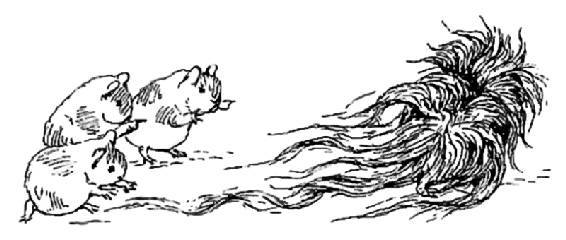
Tuppenny was a short-haired guinea-pig of dilapidated appearance. He suffered from toothache and chilblains; and he had never had much hair, not even of the shortest. It was thin and patchy. Whether this was the result of chilblains or of ill-treatment is uncertain. He was an object, whatever the cause. Obviously he was a suitable subject for experiment. “His appearance can scarcely become worse, provided he does not turn blue,” said his friend Henry P.; “let us subscribe for a small bottle, and apply it as directed.”
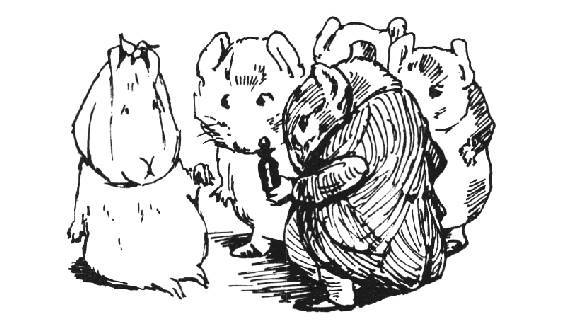
So Henry P. and nine other guinea-pigs bought a bottle and ran in a twittering crowd towards Tuppenny’s house. On the way, they overtook Tuppenny going home. They explained to him that out of sympathy they had subscribed for a bottle of moonshine to cure his toothache and chilblains, and that they would rub it on for him as Mrs. Tuppenny was out.
TUPPENNY WAS TOO DEPRESSED TO ARGUE
Tuppenny was too depressed to argue; he allowed himself to be led away. Henry P. and the nine other guinea-pigs poured the whole bottleful over Tuppenny, and put him to bed. They wore gloves themselves while applying the quintessence. Tuppenny was quite willing to go to bed; he felt chilly and damp.
Presently Mrs. Tuppenny came in; she complained about the sheets. Henry P. and the other guinea-pigs went away. After tea they returned at 5.30. Mrs. Tuppenny said nothing had happened.
The short-haired guinea-pigs took a walk; they looked in again at 6. Mrs. Tuppenny was abusive. She said there was no change. At 6.30 they called again to inquire. Mrs. Tuppenny was still more abusive. She said Tuppenny was very hot. Next time they came she said the patient was in a fever, and felt as if he were growing a tail. She slammed the door in their faces and said she would not open it again for anybody.
Henry P. and the other guinea-pigs were perturbed. They betook themselves to the market place, where Messrs. Ratton and Scratch were still trying to sell bottles by lamplight, and they asked anxiously whether there was any risk of tails growing? Mr. Scratch burst into ribald laughter; and Mr. Ratton said – “No sort of tail except pigtails on the head!”
During the night Messrs. Ratton and Scratch packed up their booth and departed from the town of Marmalade.
* * * * *
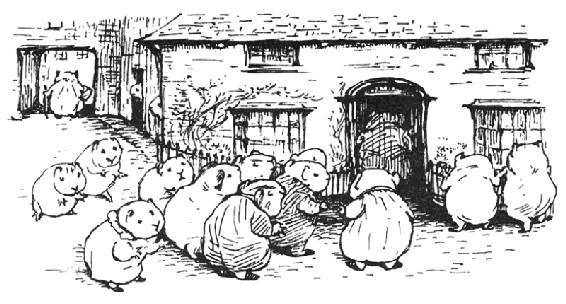
Next morning at daybreak a crowd of guinea-pigs collected on Tuppenny’s doorstep. More and more arrived until Mrs. Tuppenny came out with a scrubbing brush and a pail of water. In reply to inquiries from a respectful distance, she said that Tuppenny had had a disturbed night. Further she would not say, except that he was unable to keep on his nightcap. No more could be ascertained, until, providentially, Mrs. Tuppenny discovered that she had nothing for breakfast. She went out to buy a carrot.
Henry P. and a crowd of other guinea-pigs swarmed into the house, as soon as she was round the corner of the street. They found Tuppenny out of bed, sitting on a chair, looking frightened. At least, presumably it was Tuppenny, but he looked different. His hair was over his ears and nose. And that was not all; for whilst they were talking to him, his hair grew down onto his empty plate. It grew something alarming. It was quite nice hair and the proper colour; but Tuppenny said he felt funny; sore all over, as if his hair were being brushed back to front: and prickly and hot, like needles and pins; and altogether uncomfortable.
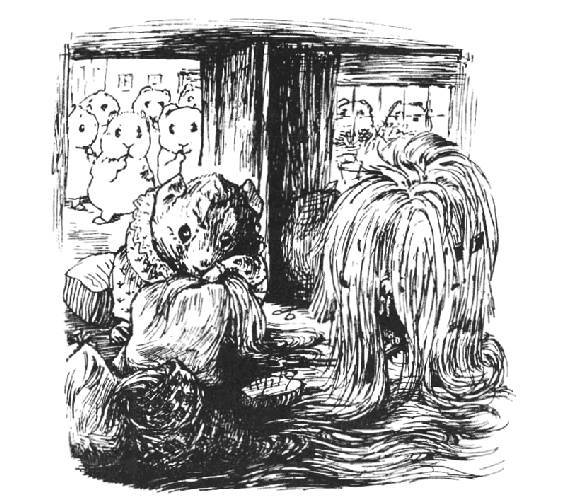
And well he might! His hair – it grew, and it grew, and it grew; faster and faster and nobody knew how to stop it! Messrs. Ratton and Scratch had gone away and left no address. If they possessed an antidote there was no way of obtaining it. All day that day, and for several days – still the hair kept growing. Mrs. Tuppenny cut it, and cut it, and stuffed pin-cushions with it, and pillow cases and bolsters; but as fast as she cut it – it grew again. When Tuppenny went out he tumbled over it; and the rude little guinea-pig boys ran after him, shouting “Old Whiskers!” His life became a burden.
STILL THE HAIR KEPT GROWING.
Then Mrs. Tuppenny began to pull it out. The effect of the quintessence was beginning to wear off, if only she would have exercised a little patience; but she was tired of cutting; so she pulled. She pulled so painfully and shamelessly that Tuppenny could not stand it. He determined to run away – away from the hair pulling and the chilblains and the long-haired and the short-haired guinea-pigs, away and away, so far away that he would never come back.
So that is how it happened that Tuppenny left his home in the town of Marmalade, and wandered into the world alone.
CHAPTER II
The Travelling Circus
In after years Tuppenny never had any clear recollection of his adventures while he was running away. It was like a bad mixed up dream that changes into morning sunshine and is forgotten. A long, long journey: noisy, jolting, terrifying; too frightened and helpless to understand anything that happened before the journey’s end. The first thing that he remembered was a country lane, a steep winding lane always climbing up hill. Tuppenny ran and ran, splashing through the puddles with little bare feet. The wind blew cold against him; he wrapped his hands in his mop of hair, glad to feel its pleasant warmth over his ears and nose. It had stopped growing, and his chilblains had disappeared. Tuppenny felt like a new guinea-pig. For the first time he smelt the air of the hills. What matter if the wind were chilly; it blew from the mountains. The lane led to a wide common, with hillocks and hollows and clumps of bushes. The short cropped turf would soon be gay with wild flowers; even in early April it was sweet. Tuppenny felt as though he could run for miles. But night was coming. The sun was going down in a frosty orange sunset behind purple clouds – was it clouds, or was it the hills? He looked for shelter, and saw smoke rising behind some tall savin bushes.
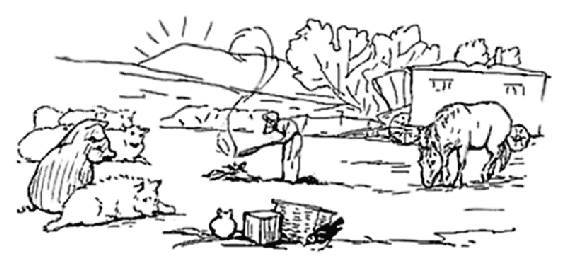
Tuppenny advanced cautiously, and discovered a curious little encampment. There were two vehicles, unharnessed; a small shaggy pony was grazing nearby. One was a two-wheeled cart, with a tilt, or hood, made of canvas stretched over hoops. The other was a tiny four-wheeled caravan. It was painted yellow picked out with red. Upon the sides were these words in capital letters – “ALEXANDER AND WILLIAM’S CIRCUS.” Upon another board was printed – The Pigmy Elephant! The Learned Pig! The Fat Dormouse of Salisbury! Live Polecats and Weasels!
The caravan had windows with muslin curtains, just like a house. There were outside steps up to the back door, and a chimney on the roof. A canvas screen fastened to light posts sheltered the encampment from the wind. The smoke which Tuppenny had seen did not come from the chimney; there was a cheerful fire of sticks burning on the ground in the midst of the camp.
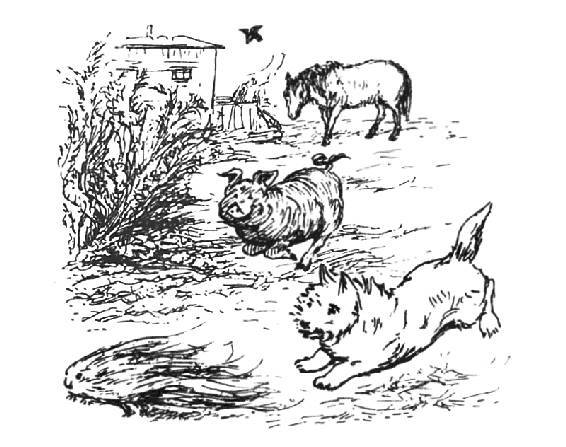
Several animals sat beside it, or busied themselves with cooking. One of them was a white West Highland terrier. When he noticed Tuppenny he commenced to bark. The pony stopped grazing, and looked round. A bird, who had been running up and down on the grass, flew up to the roof of the caravan.
TUPPENNY TURNED AND FLED.
The little dog came forward barking. Tuppenny turned and fled. He heard yap! yap! yap! and grunt, grunt, grunt! and pattering feet behind him. He tripped over his hair, and fell in a twittering heap.