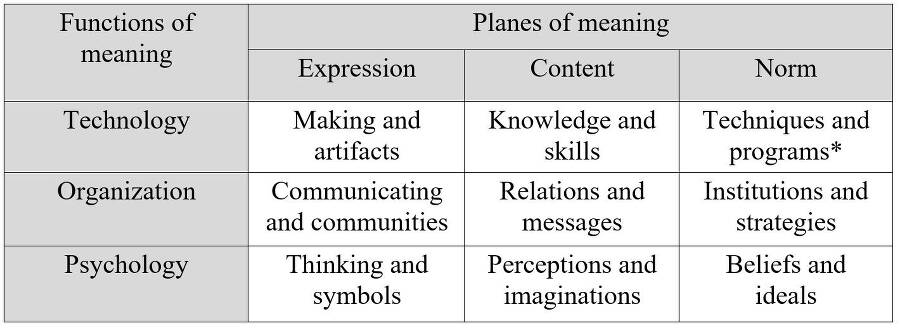
Depending on the determinateness, three planes of meaning can be detected: content, expression and norm. Meaning is inextricably linked to natural language. As Roy Harris said, a language community is not a congregation of talking heads, a tongue cannot be considered in isolation from the physical actions of humans. Humans are not just language-users, but language-makers (Harris 1980, preface). If humans make language through their actions, the opposite is also true—they define their actions through language. The idea of distinguishing between the planes of content and expression in languages comes from Louis Hjelmslev’s Prolegomena to a Theory of Language (1943). We develop his idea further:
● First, the environment is reflected in humans, their instincts, practices and intellects, thus forming the content of meanings. The plane of content embraces the significance of meanings. Meaning as such is often identified with the signification or signified. However, although the signified is in some ways closest to the human mind, meaning cannot be reduced to it.
● Second, humans, their motives, preferences and goals are reflected in the environment, shaping the expression of meanings. The expression plane contains signs as material aspects of meaning or signifiers. Man himself as a biocultural being, as a product of both biological and cultural evolution, is also to some extent an expression of meaning.
● Third, stable moments of interaction between humans and the environment are reflected in human activity and its results, forming its norms. The norms plane compiles the stable ways of functioning or principles and rules of meanings.
Three functions and three planes of meaning reveal the structure of culture. The following “table” demonstrates the nodal points at which functions and planes of meaning overlap. We do not give detailed explanations for the “table,” but invite the reader to look into it for himself. It should be noted that the actual structure of culture is of course much less ordered than shown in the “table,” which only serves to simplify and visually explain our theses.
Illustration 1. The structure of culture
* Programs and techniques are understood here in the broadest sense, like any program and any method of material action. W. B. Arthur uses the term “design” in this case (Arthur 2011, p. 91).
The initial stage of the evolution of meanings was characterized by a small variety of actions and their results. Stone and wooden tools, rules of nomadic life, knowledge and skills of hunting and gathering, simple oral language and fetishistic ideas made up the meager stock of Paleolithic meanings. The actions of Paleolithic man were limited to the appropriation and consumption of natural objects, and the means of his activity were reduced to consumer articles. He was just beginning to form a cultural niche, his home in the natural environment.
2. Uncertainty, selection and learning
Uncertainty and meaning
Reality is given to man through his actions. Uncertainty is the degree of adaptation (or, what is actually the same thing, inadaptation) of human needs and actions to reality. It is the discrepancy between reality and human needs. Complete adaptation would mean that the satisfaction of needs does not require human actions, in which case there would be no uncertainty at all. In practice, however, there are hardly any situations of complete certainty, so that man must act. Frank Knight argued that human wants are those needs that cause goal-directed action.
“We ‘need’ iodides and vitamins, and an infinite number of things of whose existence the race at large has been blissfully ignorant; but we do not ‘want’ them, because they give rise to no conflicts and hence no ‘conduct.’ The common basis of conflict, and we may say of the existence of wants at all, is the limitation in the means of gratifying some impulse or need” (Knight 1964, p. 60).
In school economics, uncertainty comes down to limited resources, to a lack of resources compared to human needs. But resource scarcity is just a special case of uncertainty. Another case is, for example, asymmetric knowledge, when one person knows something that another person does not know and uses this to deceive. Both are just special cases of uncertainty, that is, randomness, surprise, unpredictability.
Meaning as determinateness aims to adapt people and reality to each other, to overcome uncertainty. This gives meanings a great deal of inertia: people prefer to adapt and interpret meanings rather than abandon them. Talcott Parsons wrote that interpretation is the reason why sudden changes in the environment do not lead to the abandonment of the “symbolic formulae” and “elements of cultural tradition” on which social systems are based. Parsons (1964, p. 296) called this mechanism “adaptation by interpretation.” This mechanism has a long history that probably goes beyond humans: practices are derived from traditions and values of animals, simple causal models are older than intelligence itself:
“… Morality derives from values, rather than reason. Jonathan Haidt has found evidence for just this dominance. People try to justify their values by citing reasons for them, but if our reasons are demolished we conjure up others, rather than revise our values. Our reasons are revealed as a self-deceiving charade, a sham called ‘motivated reasoning.’ Reasons are anchored on values, not values on reasons” (Collier 2018, p. 35).
The inertia of meanings leads to the formation of stable meanings—norms—and to the creation of a socio-cultural order consisting of these norms. Meanings in their normative mode are those traditions and “social contracts” that enable society to function as a single whole. Order is constantly undermined by changes in the environment. In the early stages of cultural evolution, when the environment was still largely reduced to nature, order responded mainly to events and phenomena in the natural habitat. Adaptation to the environment occurs faster than the adaptation of the environment to human needs (Livi Bacci 2000, p. 4). Appropriation and consumption precede production. However, as the cultural niche expanded and developed into a cultural environment, order too had to change under the influence of cultural events and phenomena. Over time, cultural events have occurred more frequently and became increasingly unpredictable.
“Economists, typically, do not ask themselves about the structure that humans impose on themselves to order their environment, and therefore reduce uncertainty; nor are they typically concerned with the dynamic nature of the world in which we live, which continues to produce novel problems to be solved. The last point raises a fundamental issue. If we are continually creating a new and novel world, how good is the theory we have developed from past experience to deal with this novel world?” (North 2005, p. 13).
Events and phenomena are a source of uncertainty. From the perspective of order, an event is news if it represents a deviation from the norm: “An occurrence, a meaningful departure from the norm, (that is, ‘news,’ since the fulfillment of a norm is not ‘news’) depends on one’s concept of the norm” (Lotman 1977, p. 234). The socio-cultural order aims to eliminate uncertainty of events by transforming them into facts (patterns of events) and norms (programs of action). Historically, the more meaningful the appropriation process became, the more meaning humans discovered in nature. But while the uncertainty of nature slowly decreased, cultural uncertainty just as slowly increased.