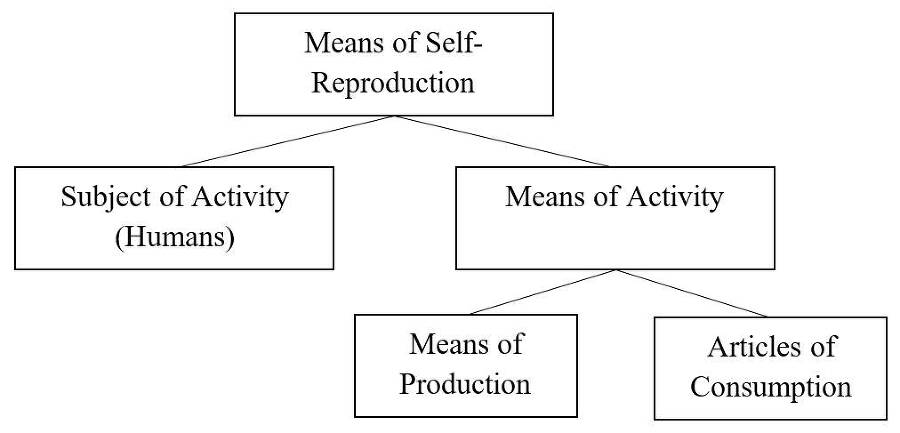
As the driving force of activity, man is an active power. Man reproduces himself through activities that consist of an immense quantity of actions. Meanings increase in cumulative cultural evolution by being divided, added and multiplied. Human activity accumulates more and more meanings; its starting point and result are man himself (his active power) and the means of his activity. Man and the means of activity together form the means of self-reproduction. The means of activity, in turn, are divided into means of production and means of consumption (consumer articles). In the course of agricultural evolution, the means of production gradually separated from consumer goods, and the experience of appropriating the creations of nature was supplemented by the experience of creating the products of culture.
Illustration 2. Means of self-reproduction
Unlike consumption, production does not aim at satisfying immediate needs, but at satisfying indirect, future needs. Economists traditionally reduce means of activity to goods. According to Carl Menger, lower-order goods aim at satisfying human needs (consumer goods), and higher-order goods (means of production) aim at producing lower-order goods in the future: “Goods of higher order acquire and maintain their goods-character, therefore, not with respect to needs of the immediate present, but as a result of human foresight, only with respect to needs that will be experienced when the process of production has been completed” (Menger 2007, pp. 81-2). In fact, however, means of activity are not reduced to goods, since people consume not only goods, but also evils (both productive and non-productive).
Besides their ability to satisfy human needs (directly as consumer articles or indirectly as means of production), means of activity have in common the fact that they are themselves products of activity. Marx introduced the concept of “abstract labor” in volume I of Das Kapital (1867) to bring all concrete types of activity to a general equivalent so that the quantity of labor can be calculated: “If then we leave out of consideration the use value of commodities, they have only one common property left, that of being products of labor” (Marx and Engels 1975-2004, vol. 35, p. 48).
Marx introduced the concept of “abstract labor” but did not explain what its substance is. Georg Simmel wrote in his The Philosophy of Money (1900) that unlike energy, which is essentially unchanging but can manifest itself in different ways (such as heat, electricity, mechanical motion), different types of labor do not have a general equivalent or substance that would allow comparisons between, for example, “muscular” and “mental” labor. At the same time, Simmel admitted that such an equivalent might exist:
“From the outset I admit that I do not simply rule out the possibility that in the future the mechanical equivalent for the psychic activity will be discovered. Of course, the importance of its content, its factually determined position in logical, ethical and aesthetic contexts is completely separate from all physical movements, roughly in the same manner as the meaning of a word is quite separate from its physiological-acoustic sound. Yet the energy that the organism must expend upon the thought of this content as a cerebral process is, in principle, just as calculable as that necessary for a muscular exertion. If this were to be achieved one day, then one could at least make the amount of energy necessary for a specific muscular exertion a unit of measurement on the basis of which the mental use of energy would be determined. Mental labor would then be dealt with on the same footing as manual labor, and its products would enter into a merely quantitative balancing of value with those of the latter” (Simmel 2004, p. 421).
As Simmel correctly assumed, the general equivalent that makes it possible to treat mental and manual labor on the same footing is not mechanical in nature. Nor is it energy or time. Rather, it is directed information: meaning is the sought-after substance of all human activity and its results.
Figurae as elements of meaning
As a building block of culture, meaning is social information in action. In genes, information is recorded in the form of nucleotide sequences. How then is information recorded in meanings? An individual meaning is made up of figurae—changes and differences. Meanings consist of both continuous and discrete figurae. Meanings are therefore similar to light, which has a wave-particle nature.
The quantity of meaning is determined by the number of figurae, or changes and differences. It applies to all functions of meaning—be it making and things, communication and communities, thinking and symbols. The quantity of meaning is in all cases determined by the number of figurae necessary for its reproduction. It is impossible to reduce meaning only to expression, only to content, or only to a norm, since every meaning is a material and social abstraction in action, taken in the unity of all the changes and differences necessary for its reproduction. As a social and material abstract action, meaning is based on the expenditure of energy and time. However, energy and time are constraints, not measures of meaning. Its quantity is measured by the number of figurae it contains.
Information theory calls changes and differences bits and measures information in bits. A bit is a change or difference that is reduced to being a change or difference and nothing else: “1” or “0,” “on” or “off,” etc. The simplest element of meaning, the simplest figura, is not just a bit (“0” or “1”) but a bit that has a valuation attached to it. The cultural bit has not only a modulus (“0” or “1”), but also a sign (“+” or “–”). Information is certainty, meaning is directed, value-based information. A meaning can be visualized as a string s consisting of figurae. The criterion for defining the size or quantity of the meaning is the number of figurae in the string s.
A string of figurae forms a meaning, a bundle of meanings forms a context. Since meanings exist in context, they function not as a discrete, but as a continuous set. There is no clearly defined, fixed boundary between figurae and meanings; this boundary is mobile and is determined by the context. The same human movement can, depending on the context, be either part of an action or an independent action with its own meaning—a gesture. Every meaning acquires its specifics in context. Meaning is always a specific action and the result of such an action. An abstract expression is a meaning only insofar as it is found in the context of concrete social actions.
Aristotle said that “art in some cases completes what nature cannot bring to a finish, and in others imitates nature” (Aristotle 1984, vol. 1, p. 340). Completeness or perfection is the main characteristic of a meaning and of culture as a whole, as compared to figurae. A finished biface is a meaning, a stone fragment is a figura. A finished phrase is a meaning, an unfinished phrase is an assortment of figurae. A well-thought-out book is a meaning; an ill-thought-out book is an assortment of figurae. Wisdom is the highest form of completeness of an action, enabling one to begin a fundamentally new action.
The relationship between figurae and meanings in their linguistic (symbolic) forms, a kind of “sense of meaning,” is the basis of the common language of all humans, which enables us to learn new languages in adulthood and to guess the purpose of rubble found during archaeological excavations. “Such non-signs as enter into a sign system as parts of signs we shall here call figurae; this is a purely operative term, introduced simply for convenience. Thus, a language is so ordered that with the help of a handful of figurae and trough ever new arrangements of them a legion of signs can be constructed” (Hjelmslev 1969, p. 44).